Showing posts with label personality. Show all posts

Saturday, June 14, 2008

Insults vs. Narcissistic injuries

The Last Psychiatrist - January 9, 2007

Narcissistic injuries have nothing to do with sadness. They are always and only about rage.

The narcissist says, "I exist." A narcissistic injury is you showing him that he does not exist in your life. Kicking him in the teeth and telling him he is a jerk is not a narcisstic injury-- because he must therefore exist.

Let's say I'm a narcissist, and you send me a 10 page letter explaining why I suck, I'm a jerk, I'm an idiot; you attack my credibility, my intelligence; and you even provide evidence for all of this, college transcripts, records from the Peters Institute, you criticize my penis size, using affidavits from past and future girlfriends-- all of this hurts me, but it is not a narcissistic injury.

A narcissistic injury would be this: I expect you to write such a letter, and you don't bother.

This is most easily seen in the failing marriage of a narcissist.

The reason it's important is because the reaction of the narcissist to either "insult" is different. In the first example, he will be sad and hurt, but he will yell back, insult you, or cry and beg forgiveness or mercy--he will respond-- maintain the relationship. He'll say and do outrageous things that he knows will cause you to respond again, to prolong your connections, even if they cause him misery. He doesn't care that it makes you and him miserable-- he cares only that there is a you and him.

But in the latter case where you ignore him, humiliate him-- an actual narcissisitic injury-- he will want to kill you.


----

And before everyone flames me, I am not trying to give a scientific explanation of the pathogenesis of narcissism. This is simply one man's opinion of how we can specify what it is, and what it may predict, past or future. Nor am I suggesting this isn't "treatable"-- anyone can change. It may not be easy, but it is always possible.

And I also do not mean to imply that all narcissists will kill everyone who injures them. The point is rage. They may never act on it, or they may break a window, or attempt suicide, etc.


January 5, 2007
Borderline

Narcissism- what I believe to be the primary disease of our times-- is one side of a coin. The other side-- the narcissist's enabler-- is the borderline.

If the analogy for narcissism is "being the main character in their own movie," then the analogy for borderline is being an actress.


Note the difference: the narcissist is a character: an invented but well scripted, complete with backstory, identity. The narcissist is trying to be something-- which already has a model. Perhaps he thinks himself an artist type, or a tough guy, or the type interested in spiritualism, or like the guy in the Matrix. Types, characters. The borderline is no one: the borderline waits for the script to define her.

Her? Yes. Narcissists are mostly hes, and borderlines hers. (Not always, sure.)

The classic description includes: intense, unstable relationships; emotional lability; fear of abandonment. The borderline has no true sense of self.

Ironically, the borderline is a borderline only in relationship to other people. The borderline has a problem with identity only because other people in the world have stronger identities. Your Dad wants you to be one way, so you do it. Your boyfriend wants a different woman; so you do it. Your husband wants something else; so you do it. Who the hell are you, really? You have no idea, because you are always molding yourself based on the dominant personality in your life.


This si done mostly out of fear of abandonment: if you don't "be" the person they want, then they'll leave you, and then what? (Borderlines don't end relationships-- they end relationships for another relationship.)

The narcissist creates an identity, then tries to force everyone else to buy into it. The borderline waits to meet someone, and then constructs a personality suitable to that person.

If a borderline is dating a guy who loves the Dallas Cowboys, then for sure, she will love the Dallas Cowboys. If, however, she breaks up with him, and then dates a guy who loves the Giants, then she'll love the Giants. But here's what makes her a borderline: she will actually believe the Giants are better. She's not lying, and she's not doing it for him; she actually thinks she thinks it's true. Everyone else on the outside sees that it is obviously a function of whom she's dating, but she is sure she came up with it on her own. And she's not play acting: at that moment that she believes, with every fiber of her being, that the Giants are better.

Here's the ironic part: if a borderline was shipwrecked on a desert island with no one around, she'd develop a real identity, of her own, not a reaction to other people. Sorry, that's not the ironic part, this is: she'd become a narcissist.

The bordeline has external markings of identity: tattoos, changing hair colors, clothes. You may recall I said almost the same thing about the narcissist: the difference is, of course, the borderline changes her image as she changes her identity-- in other words, as she cahges the dominant personality in her life; but the narcissist crafts a look, an identity, which he then defends at all costs: "I would sooner eat fire ants than shave my mustache." Of course. Of course.

All those silly movies about a woman moving away, or to the big city, and she "finds herself:" that's a borderline becoming a narcissist.

If you look back on past long term relationships you've had, and are completely perplexed as to what on earth you ever saw in each of those people that kept you with them for a year; well, there you go.

This is why narcissists marry borderlines, and not other narcisstists. Two narcissists simply can't get along: who is the main character? Meanwhile, two borderlines can't be with each other-- who supplies the identity? The narcissist thrives with the borderline because she provides for him the validation that he is, in fact, the lead; the borderline thrives with the narcissist because he defines her. And, as she will tell you every single time, without fail: "you don't know him like I do." Everyone else judges his behavior; but the borderline is judging his version of himself that she has accepted.

Go back to my white high heel shoes example. The narcissist demands his woman wear white high heel pumps not because hem ay like them himself-- he might or might not-- but because he is the type of man that would be with the type of woman who wears white pumps. He thinks he's the sophisticated, masculine man of the 1980s, so she damn well better be Kim Bassinger from 9 1/2 Weeks. Blonde hair, white pumps. She could weight 400lbs, that's not the point (though it will become one later.) So she wears the shoes, and starts to believe she likes them, starts to believe that she is that woman. He reinforces this with certain behaviors or language towards her (he'll open the door for her, push her chair in, etc. You say, "well, what's wrong with that? Nothing, except that he ALSO beats her when she doesn't wear the shoes.)

It's almost battered-wife syndrome: what keeps her with tat maniac is that when he's not beating her, it seems like he is actually being kind to her, so great is the difference between being beaten and simply not being beaten. Meanwhile everything he does wrong has an external explanation: it was the alcohol, he's under stress, etc. And she's doing this rationalizing for herself, not for him, because it is vital to her own psychological survival that he actually be who he says he is, that he actually have a stable identity that things happen to, because her identity depends on his being a foundation.

That's why the therapist has to maintain such neutrality, consistency in the sessions. It's not just to avoid conflicts; by being the most dominant (read: consistent) personality, the borderline can begin to construct one for herself using the blueprints of yours as a guide.

If the borderline sounds like a 15 year old girl, that's because that's what she is. The difference, of course, is the actual 15 year old girl is supposed to be flaky, testing identities and philosophies and looks until she finally lands on the one that's "her." But if you're 30 and doing that, well...


--------
(BTW, if you want to understand the mystery of women's addiction to shoes, here's my take: shoes are the article of clothing that represent possibility. Each shoe is a different look, a different character, and she can select "who" she wants to be that day. You might not notice the difference, but she feels it. This is not borderline-- it's normal, but it's normal because the shoe changes and the rest of her doesn't.)

March 7, 2007
The Psychological Uncertainty Principle


cat


A commenter, who I believe is a physics undergrad (his blog here) emailed me some of his thoughts on narcissism, and wrote:

...those studies where people rank each other in a room for different attributes having never met them... I think what's going on is we assign people personalities based on how they look and force them to become a certain thing, creating a whole custom world for them...

which puts the idea of "profiling" on its head. Do we actually ever "figure people out," or do we change them into what we think they are by the act of engaging in a relationship (on any level) with them? It sounds a lot like a psychological version of quantum entanglement:

When two systems, of which we know the states by their respective representatives, enter into temporary physical interaction due to known forces between them, and when after a time of mutual influence the systems separate again, then they can no longer be described in the same way as before, viz. by endowing each of them with a representative of its own... By the interaction the two representatives have become entangled.

Which, unfortunately, sounds a lot like this (p. 236):

The unreflective consciousness does not apprehend the person directly or as its object; the person is presented to consciousness in so far as the person is an object for the Other. This means that all of a sudden I am conscious of myself escaping myself, not in that I am the foundation of my own nothingness but in that I have my foundation outside myself. I am for myself only as I am a pure reference for the Other.

You can't know who a person is without relating to them, and once you do that, you irrevocably change them.

Only in relationship to another do you get defined. Sometimes you can do it with your God; but either way, any adjective has to be placed on you by someone else. Are you brave? Strong? funny, stupid, nervous? All that comes from someone else. So when someone relates to you, they define you. You can try to control this-- hence the narcissist preying on the borderline to get her to see him the way he wants to be seen-- but ultimately it's up to the other person.

So we're are, or become, whatever a person thinks we are? No, it's worse than that-- we want to be what they think we are. That's why we maintain the relationship, otherwise we'd change it. ("I divorced her because I didn't like who I became.")

We do it because it is easier, and it serves us. You're kind because he sees you as kind-- which in turn allows him to be seen as someone who can detect kindness. And you accept that you're kind-- or mean/vulnerable/evil/brilliant-- because it serves you-- there's some gain there. But a strong person accepts that on the one hand the other person gives you definition, and on the other hand you are completely undefinable, free, at any moment, to redefine yourself. You can defy him, biology, environment and be anything.

You say: but I can't be a football star just because I want to. But that's wanting someone else to see you in a certain way. Do you want to play ball? Go play ball. "But I won't get on the team." Again, that's wanting to change someone else. Change you first.

But what about-- identity? That's the mistake, that's bad faith. Thinking that our past is us; what we did defines us. Our past can be judged-- what else is there to judge?- but it can't-- shouldn't-- define us, because at any moment we are free to change into something, anything else. And so, too, we can be judged for not changing.
Ultimately, you are responsible for everything you do and think. Not for what happens to you, but for how you choose to react. Nothing else made you be. Nothing else made you do.

Trinity said it best: The Matrix cannot tell you who you are.

The New Narcissism

December 29, 2006
If This Is One of The Sexiest Things You've Ever Seen, You May Be a Narcissist


A quick primer on the new Narcissism.

I don't mean the traditional Kernberg, Kohut, or even Freudian descriptions. In the modern times, I think narcissism has evolved.

A narcissist isn't necessarily an egotist, someone who thinks they are the best. A quick screen is an inability to appreciate that other people exist, and have thoughts, feelings, and actions unrelated to the narcissist. These thoughts don't have to be good ones, but they have to be linked to the narcissist. ("I'm going to get some gas-- because that jerk never fills the car.")

The narcissist believes he is the main character in his own movie. Everyone else has a supporting role-- everyone around him becomes a "type." You know how in every romantic comedy, there's always the funny friend who helpes the main character figure out her relationship? In the movie, her whole existence is to be there fore the main character. But in real life, that funny friend has her own life; she might even be the main character in her own movie, right? Well the narcissist wouldn't be able to grasp that. Her friends are always supporting characters, that can be called at any hour of the night, that will always be interested in what she is wearing, or what she did. That funny friend isn't just being kind, she doesn't just want to help-- she's personally interested in the narcissist's life. Of course she is.

A comedian I can't remember made a joke about actors in LA, but it's applicable to narcissists: when two narcissists go out, they just wait for the other person's mouth to stop moving so they can talk about themselves.

So on the one hand, the narcissist reduces everyone else to a type, as it relates to himself; on the other hand, the narcissist, as the main character in his movie, has an identity that he wants (i.e. he made it up) and requires all others to supplement that identity.

A narcissist looks the same every day; he has a "look" with a defining characteristic: a certain haircut; a mustache; a type of clothing, a tatoo. He used these to create an identity in his mind that he will spend a lot of energy keeping up.

Consider the narcissist who wants his wife to wear only white, high heeled pumps. The narcissist wants this not because he himself likes white high heel pumps-- which he might-- but because the type of person he thinks he is would only be with the type of woman who wears white high heeled pumps. Or, in other terms, other people would expect someone like himself to be with a woman who wears those shoes. What he likes isn't the relevant factor, and certainly what she likes is irrelevant. What matters is that she (and her shoes) are accessories to him.

Never mind that the woman is obese, or 65, or the shoes out of style, or impractical-- the shoes represent something to him, and he is trying to reinforce his identity through that object.

Narcissists typically focus on specific things as proxies for their identity. As in the example above, that the woman might be obese or a paraplegic could be ignored if the footwear was the proxy for identity. These proxies are also easy to describe but loaded with implication: "I'm married to a blonde." Saying "blonde" implies something-- e.g. she's hot-- that might not be true. But the narcissist has so fetishized "blondeness" that it is disconnected from reality. The connotations, not the reality, are what matters (especially if other people can't check.)

This explains why narcissists feel personally sleighted when the fetishized object disappears. "My wife stopped dying her hair blonde; but when she used to date her other boyfriends, she was in the salon every month. Bitch." He doesn't see the obvious passage of time, what he sees is part of his identity being taken from him, on purpose. Here's the final insult: "she obviously doesn't care about me as much as her old boyfriends."

As a paradigm, the narcissist is the first born (or only) child, aged 2-3. Everything is about him, and everything is binary. His, or not his. Satisfied, or not satisfied. Hungry, or not hungry. Mom and Dad are talking to each other and not me? "Hello! Focus on me!" Youngest children don't typicaly become narcissists because from the moment of their birth, they know there are other characters in the movie. (Youngest more easily becomes borderline.) Control, of course, is important to a narcissist. If you can imagine a 40 year old man with the ego of a 2 year old, you've got a narcissist.

Obviously, not all first borns go on to be narcissists. Part of their development comes from not learning that there is a right and wrong that exists outside them. This may come from inconsistent parenting:

Dad says, "you stupid kid, don't watch TV, TV is bad, it'll make you stupid!" Ok. Lesson learned. But then one day Dad has to do some work: "stop making so much noise! Here, sit down and watch TV." What's the learned message? It isn't that TV is sometimes good and sometimes bad. It's that good and bad are decided by the person with the most power.

So the goal in development is to become the one with the most power. Hence, narcissists can be dogmatic ("adultery is immoral!") and hypocrites ("well, she came on to me, and you were ignoring me at home") at the same time. There is no right and wrong-- only right and wrong for them. He's an exaggerated example: if they have to kill someone to get what they want, then so be it. But when they murder, they don't actually think what they're doing is wrong--they're saying, "I know it's illegal, but if you understood the whole situation, you'd understand..."

Narcissists never feel guilt. Only shame.

Parenting & Personality

May 20, 2006
Parenting and Personality Disorders

A fascinating article that no one will ever actually read: Parenting Behaviors Associated With Risk For Offspring Personality Disorder During Adulthood.

The authors made a (startling) discovery: there are types of parenting behaviors which predispose your kid to growing up personality disordered.

This was a longitudinal study of 592 families, first assessed when the kids were about 5, and then again when they were in their 30s. (More info at their website http://nyspi.org/childcom/)

The results are pretty much what you'd expect:


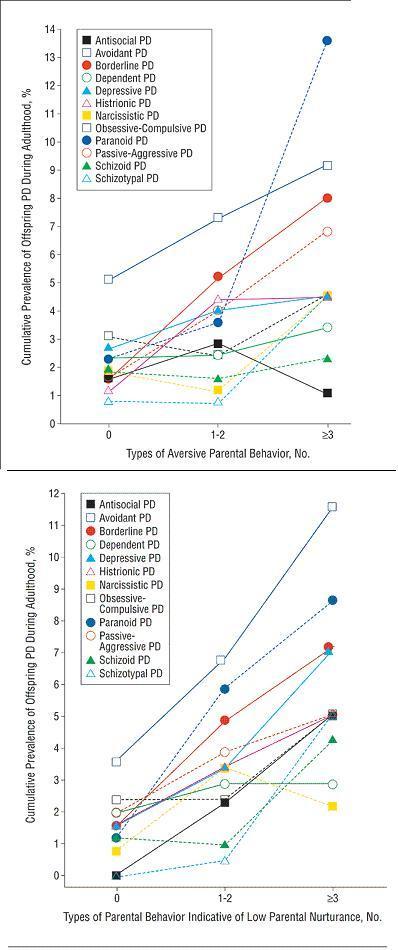
The more of these behaviors the parents exhibited, the more the risk of PD increased. What is interesting is which PD was increased given the number of parental behaviors:

First, overall number of bad parental behaviors:

(antisocial=criminal; avoidant=shy; narcissistic=self-absorbed)

Prevalence of PD vs. # parenting behaviors


You'll notice that antisocial PD is essentially zero at baseline, and is dramatically sensitive to bad parenting. Contrast this with avoidant PD, which, while also sensitive to the parenting, starts out higher at baseline. In other words, you may be born shy, but not antisocial.

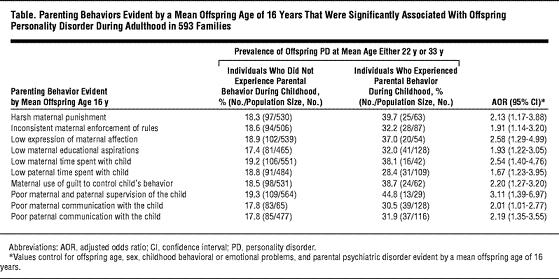
Looking at specific types of bad parenting:


What you'll see in the top figure is that being an aversive parent is a great way of making someone borderline or passive-aggressive, not to mention paranoid. But it doesn't make them antisocial. Hmm.

Meanwhile, having low affection or low nurturing scores increased the risk for antisocial, as well as everything else (but especially avoidant, paranoid, depressive, borderline).

Some covariate caveats: even when parental psychaitric disorders and offspring behavioral problems at age 6 were controlled, bad parenting was still associatd with increased risk of their kids' PD.

Furthermore, the usual association of parental psychiatric disorder leading to child PD could be explained, in fact, 95% due to the bad parenting. Another way of saying this is that 95% of the effect that a parental psychiatric disorder has on causing their kids' personality disorder can be obviated by better parenting. In a similar vein, 35% of the effect of childhood behavioral problems leading to later PD can be similarly reduced by better parenting. In other words, even if you or your kids have a "biological" psychiatric disorder, better parenting skills can darmiatically affect the outcome.

It is not an insignificant fact that only one of the 5 authors was an MD (oddly, he is also a PhD but does not list this in the authorship line.). The nature vs. nurture debate in psychiatry is all but dead.

The longer we delude ourselves that biology controls behavior, and not the other way around, the longer we'll have to live with the same behaviors.

The Uncertainty Principle

The Last Psychiatrist, March 7, 2007

A commenter emailed me some of his thoughts on narcissism, and wrote:

...those studies where people rank each other in a room for different attributes having never met them... I think what's going on is we assign people personalities based on how they look and force them to become a certain thing, creating a whole custom world for them...

which puts the idea of "profiling" on its head. Do we actually ever "figure people out," or do we change them into what we think they are by the act of engaging in a relationship (on any level) with them? It sounds a lot like a psychological version of quantum entanglement:

When two systems, of which we know the states by their respective representatives, enter into temporary physical interaction due to known forces between them, and when after a time of mutual influence the systems separate again, then they can no longer be described in the same way as before, viz. by endowing each of them with a representative of its own... By the interaction the two representatives have become entangled.

Which, unfortunately, sounds a lot like this (p. 236):

The unreflective consciousness does not apprehend the person directly or as its object; the person is presented to consciousness in so far as the person is an object for the Other. This means that all of a sudden I am conscious of myself escaping myself, not in that I am the foundation of my own nothingness but in that I have my foundation outside myself. I am for myself only as I am a pure reference for the Other.

You can't know who a person is without relating to them, and once you do that, you irrevocably change them.

Only in relationship to another do you get defined. Sometimes you can do it with your God; but either way, any adjective has to be placed on you by someone else. Are you brave? Strong? funny, stupid, nervous? All that comes from someone else. So when someone relates to you, they define you. You can try to control this-- hence the narcissist preying on the borderline to get her to see him the way he wants to be seen-- but ultimately it's up to the other person.

So we're are, or become, whatever a person thinks we are? No, it's worse than that-- we want to be what they think we are. That's why we maintain the relationship, otherwise we'd change it. ("I divorced her because I didn't like who I became.")

We do it because it is easier, and it serves us. You're kind because he sees you as kind-- which in turn allows him to be seen as someone who can detect kindness. And you accept that you're kind-- or mean/vulnerable/evil/brilliant-- because it serves you-- there's some gain there. But a strong person accepts that on the one hand the other person gives you definition, and on the other hand you are completely undefinable, free, at any moment, to redefine yourself. You can defy him, biology, environment and be anything.

You say: but I can't be a football star just because I want to. But that's wanting someone else to see you in a certain way. Do you want to play ball? Go play ball. "But I won't get on the team." Again, that's wanting to change someone else. Change you first.

But what about-- identity? That's the mistake, that's bad faith. Thinking that our past is us; what we did defines us. Our past can be judged-- what else is there to judge?- but it can't-- shouldn't-- define us, because at any moment we are free to change into something, anything else. And so, too, we can be judged for not changing.

Ultimately, you are responsible for everything you do and think. Not for what happens to you, but for how you choose to react. Nothing else made you be. Nothing else made you do.

Trinity said it best: The Matrix cannot tell you who you are.
Reciprocal Determinism And Why Punching People Out Is Way Cool

And stay away from my man!

A quick addendum to my previous post on the "Psychological Uncertainty Principle."

A reader pointed out that some of this is explained by "reciprocal determinism", which basically means that you respond to your environment, but then force a change in your environment which further changes your behavior. For example:

  1. "Girls don't like me. Girls don't like me. Girls don't like me." Repeat x 100.
  2. So a girl thought she liked you, but then met you, and now decided you're a nutter. So she bolts.
  3. Now you have proof girls don't like you.

It sounds like reciprocal determinism says who you are affects your environment, which then affects you.

That's wrong. In the above example, it wasn't ever true that girls didn't like you. You made it true. You changed your behavior, somehow, that made it so that girls don't like you. You received some gain from making it true that girls didn't like you-- perhaps it helps you avoid intimacy, etc, etc.

So your identity never enters the equation. Reciprocal determinism is about behavior, not identity. Albert Bandura (the originator of this concept) was responding to Skinner's behaviorism.

Wikipedia's article on reciprocal determinism is a perfect example of this exactly wrong use of the concept. They describe how low MAOA enzyme can cause you to be antisocial. In fact, it is the opposite: having low MAO-A does nothing, but having high MAO-A seems to be protective. The reason people became antisocial (synonymous with criminal) in those studies was that they were abused-- in essence, they imitated the behavior.

The experiment Bandura is famous for speaks to my point about the absoluteness of your responsibility for your identity: kids watched adults beat up a bobo doll, and were then put in a room with a bobo doll, and, surprise, the majority then imitated this behavior, even using the same hitting techniques and repeating the same phrases the adults did. Nothing genetic or even environmental affected this outcome-- almost all the kids did it (and almost none of the control kids who didn't watch the adults beat up the doll).

So watching the Matrix causes kids to go Columbine? Bandura would have said yes. But oddly no one ever wonders why then the cooking channel doesn't result in more pies, or why porn hasn't prompted rampant depilation. Bandura's theory of reciprocal determinism required a key element: reinforcement. There has to be a gain in the imitation, in the identification. You may have "learned" the violence by watching it, but you won't display the violence unless there is some reward-- it isn't just a reflex, some part of your core identity. You decide to imitate it, because it rewards you. How? "I want to be just like my Dad" (except he beats Mom.) "Neo is so cool." (Didn't he kill all the human security guards?) "Thug life!" Etc. Note that no one ever imitates the violence of, say, Gollum. Want to know why? Because Gollum never scores any chicks.

So once again, you pick who you are. Or: you picked who you are, how you behave, whether you know this or not. So now ask: why did you pick this person, this identity? And what is preventing you from changing any or all of it?

Borderline PD

From The Last Psychiatrist - October 23, 2007

The Diagnosis of Borderline Personality Disorder: What Does It Really Mean?

A diagnosis of borderline personality disorder could, theoretically, mean that the psychiatrist made a serious attempt at evaluating defense mechanisms and ego integrity; or at least a matching of symptoms to DSM criteria. It's theoretically possible, yes. Other things that are theoretically possible include alien abduction, peace in our time, dual eigenstates, user friendly Movable Type upgrades, political discussions that don't rely on information from John Stewart, Daleks, recession with low unemployment, Independents, Madonna/whores, a benignly rising Russia.

Let's assume there's a difference between a diagnosis and a heuristic.

A diagnosis is based on pathology, or at least on a set of predetermined criteria. I diagnosis must be both reliable-- multiple doctors would find the same diagnosis when given the same information, and valid-- the diagnosis actually is the thing you say it is.

Many psychiatrists devalue diagnoses into heuristics, that is, they have intuitive "rules of thumb" that are extensions of their own cognitive biases. This isn't automatically good or bad; the heuristic is only as helpful as the bias. For example, if the last ten people who you saw that smoked crack also had syphilis, on the 11th you might apply the heuristic, "where there's crack, so there be syphilis, better get a blood test." Unfortunately, it could be applied the other way: the 11th patient with syphilis you see gets prejudged as a crack addict.

The diagnosis of a personality disorder is supposed to be valid, it's supposed to mean something. However, in general they are diagnosed very unrigorously, if such a thing can be imagined of psychiatrists. They carry nearly none of the implications of causality (except, once in a while, sexual abuse), nor do they reflect a distinctive understanding of a person's personality (e.g. borderline as distinct from narcissism.)

A good example is borderline. If a psychiatrist calls it borderline, it may or may not be, actually, borderline personality, a la Kernberg. So if a patient happens to know she was diagnosed with borderline (which she rarely will-- it's kept secret or encoded as "bipolar") it doesn't mean she can look it up on the internet for more information, because that's not what the psychiatrist meant by the diagnosis. "Articulate" has a certain meaning, look in the dictionary; it is fairly consistent throughout all settings except one: when it is used by a white guy to describe a black guy. In that case, the word suddenly means something completely different than it ordinarily does: it means "not hung up about race." Here's the point: the black guy may actually be articulate, or not be articulate-- who knows? But white people know exactly what it means in that context. Similarly borderline: you may, indeed, have a borderline personality, or may not; but the diagnosis to the psychiatrist means something else. n other words, it's not at all a diagnosis, it's a heuristic.(1)

Devoid as these personality disorder heuristics are of their originally intended meanings, they do, however, reliably imply the same things to other psychiatrists. Those "things" however, are uncoupled from the "official" diagnosis. The heuristic may have a lot, or absolutely no, relationship to the diagnosis. In other words, the term "borderline" is immensely reliable among psychiatrists, but not at all between psychiatrists and non-psychiatrists, who think it means something else. What psychiatrists should have done is invented their own special word for the heuristic of "borderline." But they're lazy.

So, as a public service, I'll tell you what psychiatrists mean when they say borderline. Once again, I'm saying that this is how the diagnosis is used by many psychiatrists. If you email me and say that I'm a jerk for not understanding the term, then you need to go buy yourself a helmet.

First, borderline is a heuristic of countertransference: if the psychiatrist feels frustrated, or exasperated, then the patient is borderline.

Second, borderline is meant as a synonym for any of the following: needy, argumentative, touchy/hypersensitive.

Third, it is generally reserved for the following four types:

1. Very attractive female, who comes for problems the psychiatrist considers ordinary: men, work/school, problems with parents, etc. It is diagnosed here most often by female psychiatrists, and carries the connotation: "Grow up."
2. Overweight, typically white, female, who needs/wants benzos, especially Klonopin. The implications are lack of self-control, and reliance on external supports.
3. Thin female with a lot of anger. By example, the woman who comes for treatment of "depression" but describes most life events in terms of attacks, sleights, harm, etc-- i.e. power differentials.
4. Gay man.

If you are a patient, my point in telling you this iss not "why did they diagnose me with borderline?" but rather, "oh my God, are you telling me he thinks I'm borderline just because I told him if I don't get my twice a day klonopins, I'll freak out?"

Again, these aren't even accurate descriptions of the formal diagnosis borderline; number 3, for example, is better described as narcissism, especially when anorexia (restricting type) is involved. But her anger makes the psychiatrist uncomfortable, so it gets labeled as borderline.(2) I hope you see two obvious problems: first, the term is used pejoratively; but, more importantly, giving something a label alters the environment, in this case in the wrong way. The above #3 female doesn't need limit setting, she needs mirroring transference, etc. (And don't forget about the narcissistic injury.)

But again, even though the term is used improperly and probably leads to worse treatment for the patient, it does mean the same wrong thing to most psychiatrists. So when I'm being referred a "30 year old borderline," I know almost exactly what I'm getting, even though it has nothing to do with borderline. Frustrating? You betcha.

But the sleight of hand is that it sounds like personality disorders are crappy and unreliable diagnoses and have little in common with their original meaning. In fact, most psychiatric diagnosis are equally crappy and unreliable. When you read articles saying "borderline is a pejorative term, and these patients are often really bipolar" what you need to understand is that "bipolar" is not a more valid or reliable diagnosis, it's simply another heuristic. It isn't less pejorative, it isn't more "real." It carries a different set of implications, but it isn't a more rigorous, more "biological" classification. It's not like saying, "it's not a unicorn, it's a rhinoceros." It is like saying, "it's not a unicorn, it's a pegasus."

This, by the way, is the reason why so many defenders of psychiatric diagnoses can't accept that "borderline" and "bipolar" are equally subjective terms. They say, "the diagnosis of borderline has very poor inter-rater reliability; bipolar has high inter-rater reliability." But reliability is not the same as validity. If you take twenty thousand members of the KKK, and ask them to "diagnose" the problem of contemporary society, their answer will be the same, i.e. reliable. But it's wrong, obviously. The diagnosis of bipolar is reliable, but in the same way as the KKK's diagnosis of society's ills was reliable. It may be completely wrong, it may be completely right, it may be partly right, partly wrong, in some cases but not others, etc.

If you want to know why I've used racial analogies throughout this post, it's because these are all, in essence, prejudices. "It's bipolar." "It's borderline." "It's poverty." "It's bad parenting." "It's..." Well? It's not really any of those after all, is it?


January 5, 2007
Borderline

Narcissism- what I believe to be the primary disease of our times-- is one side of a coin. The other side-- the narcissist's enabler-- is the borderline.

If the analogy for narcissism is "being the main character in their own movie," then the analogy for borderline is being an actress.


Note the difference: the narcissist is a character: an invented but well scripted, complete with backstory, identity. The narcissist is trying to be something-- which already has a model. Perhaps he thinks himself an artist type, or a tough guy, or the type interested in spiritualism, or like the guy in the Matrix. Types, characters. The borderline is no one: the borderline waits for the script to define her.

Her? Yes. Narcissists are mostly hes, and borderlines hers. (Not always, sure.)

The classic description includes: intense, unstable relationships; emotional lability; fear of abandonment. The borderline has no true sense of self.

Ironically, the borderline is a borderline only in relationship to other people. The borderline has a problem with identity only because other people in the world have stronger identities. Your Dad wants you to be one way, so you do it. Your boyfriend wants a different woman; so you do it. Your husband wants something else; so you do it. Who the hell are you, really? You have no idea, because you are always molding yourself based on the dominant personality in your life.


This si done mostly out of fear of abandonment: if you don't "be" the person they want, then they'll leave you, and then what? (Borderlines don't end relationships-- they end relationships for another relationship.)

The narcissist creates an identity, then tries to force everyone else to buy into it. The borderline waits to meet someone, and then constructs a personality suitable to that person.

If a borderline is dating a guy who loves the Dallas Cowboys, then for sure, she will love the Dallas Cowboys. If, however, she breaks up with him, and then dates a guy who loves the Giants, then she'll love the Giants. But here's what makes her a borderline: she will actually believe the Giants are better. She's not lying, and she's not doing it for him; she actually thinks she thinks it's true. Everyone else on the outside sees that it is obviously a function of whom she's dating, but she is sure she came up with it on her own. And she's not play acting: at that moment that she believes, with every fiber of her being, that the Giants are better.

Here's the ironic part: if a borderline was shipwrecked on a desert island with no one around, she'd develop a real identity, of her own, not a reaction to other people. Sorry, that's not the ironic part, this is: she'd become a narcissist.

The bordeline has external markings of identity: tattoos, changing hair colors, clothes. You may recall I said almost the same thing about the narcissist: the difference is, of course, the borderline changes her image as she changes her identity-- in other words, as she cahges the dominant personality in her life; but the narcissist crafts a look, an identity, which he then defends at all costs: "I would sooner eat fire ants than shave my mustache." Of course. Of course.

All those silly movies about a woman moving away, or to the big city, and she "finds herself:" that's a borderline becoming a narcissist.

If you look back on past long term relationships you've had, and are completely perplexed as to what on earth you ever saw in each of those people that kept you with them for a year; well, there you go.

This is why narcissists marry borderlines, and not other narcisstists. Two narcissists simply can't get along: who is the main character? Meanwhile, two borderlines can't be with each other-- who supplies the identity? The narcissist thrives with the borderline because she provides for him the validation that he is, in fact, the lead; the borderline thrives with the narcissist because he defines her. And, as she will tell you every single time, without fail: "you don't know him like I do." Everyone else judges his behavior; but the borderline is judging his version of himself that she has accepted.

Go back to my white high heel shoes example. The narcissist demands his woman wear white high heel pumps not because hem ay like them himself-- he might or might not-- but because he is the type of man that would be with the type of woman who wears white pumps. He thinks he's the sophisticated, masculine man of the 1980s, so she damn well better be Kim Bassinger from 9 1/2 Weeks. Blonde hair, white pumps. She could weight 400lbs, that's not the point (though it will become one later.) So she wears the shoes, and starts to believe she likes them, starts to believe that she is that woman. He reinforces this with certain behaviors or language towards her (he'll open the door for her, push her chair in, etc. You say, "well, what's wrong with that? Nothing, except that he ALSO beats her when she doesn't wear the shoes.)

It's almost battered-wife syndrome: what keeps her with tat maniac is that when he's not beating her, it seems like he is actually being kind to her, so great is the difference between being beaten and simply not being beaten. Meanwhile everything he does wrong has an external explanation: it was the alcohol, he's under stress, etc. And she's doing this rationalizing for herself, not for him, because it is vital to her own psychological survival that he actually be who he says he is, that he actually have a stable identity that things happen to, because her identity depends on his being a foundation.

That's why the therapist has to maintain such neutrality, consistency in the sessions. It's not just to avoid conflicts; by being the most dominant (read: consistent) personality, the borderline can begin to construct one for herself using the blueprints of yours as a guide.

If the borderline sounds like a 15 year old girl, that's because that's what she is. The difference, of course, is the actual 15 year old girl is supposed to be flaky, testing identities and philosophies and looks until she finally lands on the one that's "her." But if you're 30 and doing that, well...


--------
(BTW, if you want to understand the mystery of women's addiction to shoes, here's my take: shoes are the article of clothing that represent possibility. Each shoe is a different look, a different character, and she can select "who" she wants to be that day. You might not notice the difference, but she feels it. This is not borderline-- it's normal, but it's normal because the shoe changes and the rest of her doesn't.)

Narcissism in Society

From The Last Psychiatrist - December 17, 2006

Time's Person of the Year Is Someone Who Doesn't Actually Matter

That would be you.

The short version of the Time article is that we as individuals have formed a community on the internet (YouTube, MySpace, Wikipedia, etc), and this community is starting to "build a new kind of international understanding, not politician to politician... but person to person."

Ok, no. Wrong, wrong, wrong all over the place.

The author of this piece is Lev Grossman. Grossman is fairly famous book critic, one of the better ones. He also wrote a novel that's a nod to Borges. This isn't bad, it's just context.

The entire problem with Grossman's premise is exemplified by his first paragraph:

The "Great Man" theory of history is usually attributed to the Scottish philosopher Thomas Carlyle, who wrote that "the history of the world is but the biography of great men." He believed that it is the few, the powerful and the famous who shape our collective destiny as a species. That theory took a serious beating this year.

Well, not exactly. Grossman's thesis is that we matter, we can shape our destinies; he puts that in contrast to Carlyle's premise that great men help shape destiny. But that's not what Carlyle actually says. Here's the actual quote:

In all epochs of the world's history, we shall find the Great Man to have been the indispensable savior of his epoch;--the lightning, without which the fuel would never have burnt. The History of the world, I said already, was the biography of Great Men.

Carlyle doesn't say great men shape destiny; he says great men, and only great men, cause history. These great men should be given power to run society because only they can be trusted to do it. Great men actually drive history, not shape it.
Democracy can't be trusted. Paternalistic socialism, or at least a non-hereditary, anti-capitalist, aristocracy is all that can keep us from the dark of ochlocracy. Individuals trump ideology-- which sounds like a good motto, except when individuals means Stalin and ideology means liberalism. Oh, and the last book Hitler read was Carlyle's History of Friedrich of Prussia.

So Grossman is not really paraphrasing Carlyle correctly. This is important because Grossman is a book critic with a PhD from Harvard in comparative literature. Either he simply did not know this about Carlyle, which I have to assume is impossible, or it didn't matter: he commandeered the quote, stripped it of the meaning Carlyle intended and used it the way he needed to use it. And that exactly describes the problem: truth and reality aren't important, what's important is you.

Because "You" as Person of the Year is actually quite portentuous. It's is both representative and symptomatic of the problem of our times: narcissism. Nowadays we are so alienated and matter so very little to larger society that the only thing that inflames any passion is to be reminded of this. Consider Bush and Cheney. Put aside politics for a moment, it is clear that their single-mindedness of purpose ignores each of us as individuals. Give them the benefit of the doubt, that they are doing what they think is best. But it's best for society, for America: what we hate is that it isn't for us, for you, for me. That's what people hate about them, the seeming indifference to our individual worth, to our sense of importance. Our votes don't count; everything is about religion; "Global War On Terror." Where in all that is the individual? We are tools to their "higher cause." I know people say that they are angry at the cause; but I think it's really anger that we're being used for anything.

Being on YouTube, having a blog, having an iPod, being on MySpace-- all of these things are self-validating, they allow that illusion that is so important to narcissists: that we are the main characters in a movie. Not that we're the best, or the good guys, but the main characters. That everyone around us is supporting cast; the funny friend, the crazy ex, the neurotic mother, the egotistical date, etc. That makes reminders of our insignificance even more infuriating.

Take a look at the photos in the Time article: a DJ, a punk rocker, a guy in dredlocks, a kid dancing with headphones, a guy singing into a mic, a hot chick taking a photo of herself-- none of these people could ever be "Person of the Year." They barely have identities outside of their image. (And observe how so many are defined through music they listen to.) They must be defined by something from without, like a tattoo. But they deserve everything anyone else can have. It's their right.

I'm not saying each of us as individuals is insignificant. We should, could, matter. But to protect ourselves from an existential implosion, we decide to define ourselves through images and signs, rather than behaviors; lacking an identity founded in anything real makes us vulnerable to anger, resentment. But no guilt, ever. The narcissist never feels guilt. He feels shame.

It can't last. If society chooses to make narcissism the default, it's going to have to deal with society-wide narcissistic injuries-- when we suddenly realize that it isn't solely our movie and we're really not the main character. And no one wants to see this stupid movie anyway. This inevitably leads to violence: the school shooting, inexplicable knifing over Play Station 3, Andrea Yates, beating the wife because she wore the wrong shoes type of violence. Oh, they weren't white high heeled pumps? That bitch! She used to wear them for her old boyfriend.

I'm not sure anyone in psychiatry sees this-- they are too busy documenting Pharma excesses and Lamictal outcomes-- but it is the problem of our times. The only ones who seem to notice are advertisers, marketers-- they see it. They don't judge it, they simply profit from it.

Grossman could morph Carlyle into what he wanted because Carlyle doesn't matter, what matters is what Grossman wanted, what Grossman needed. Carlyle doesn't exist, or he only exists as we need to use him. He becomes a tool, another supporting character. Anyone actually read anything by Carlyle anymore? Why bother? We only need a few soundbites for our own use. Grossman is a clearly a good writer and hardly the problem here. But picking "You" as Person of the Year only reinforces the collective delusion that our individual selves matter more than other person, or a collective good, an ideology, truth, or right and wrong. It's relativism with a cherry twist.

It won't last. It absolutely can't.